

Ten days in Greece gave us a little bit of everything: ancient history, lively city streets, beautiful islands, excellent food and a small-ship cruise that took us to places that larger ships simply cannot reach.
There are some trips where the individual experiences are memorable. And then there are trips where the way everything comes together makes the whole holiday special.
Our September trip to Greece was very much the latter.
We combined three nights in Athens with a seven-night cruise around the Greek islands aboard Azamara Onward. It gave us enough time to experience Athens properly before heading to the islands, while the cruise allowed us to see a surprisingly large amount of the Aegean without constantly packing and unpacking.
It was, in many ways, exactly the sort of holiday we enjoy.
Flying Club Europe to Athens
Our journey began at Heathrow, flying Club Europe from Terminal 5 on the lunchtime flight to Athens.
We made use of the British Airways lounge facilities at T5. The lounge near the Concorde Room was pleasant enough, although the Galleries lounge was extremely busy when we visited and finding a seat was difficult.
One little BA lounge tip that we have picked up over the years: if you want champagne, ask a member of staff.
It isn’t always particularly obvious, but champagne is available and staff will happily provide it. It is certainly worth asking.
The flight itself was excellent, and one of the pleasant surprises was how quickly we got through Athens airport. Security was virtually queue-free and our luggage appeared quickly.
Within no time at all we had met Dennis, our pre-arranged driver, and were heading towards central Athens.
Athens: history on your doorstep
The journey from the airport to central Athens took around 40 minutes, and we were soon arriving at our base for the next three nights: AthensWas Hotel in Plaka.
The location could hardly have been better.
The hotel is effectively a minute from the Acropolis, with restaurants, bars and the narrow streets of Plaka immediately outside. Our Deluxe room on the second floor was spacious, with an enormous balcony overlooking the busy street below.
The room itself was excellent, with a particularly large bathroom and plenty of storage and hanging space – something that becomes surprisingly important when you’re travelling with luggage for ten days.
But the real treat was breakfast.
The restaurant is on the top floor, and sitting down to breakfast with the Acropolis dominating the skyline is a wonderful way to start the day. The food was excellent, with a good à la carte selection, but it was the view that made breakfast particularly memorable.
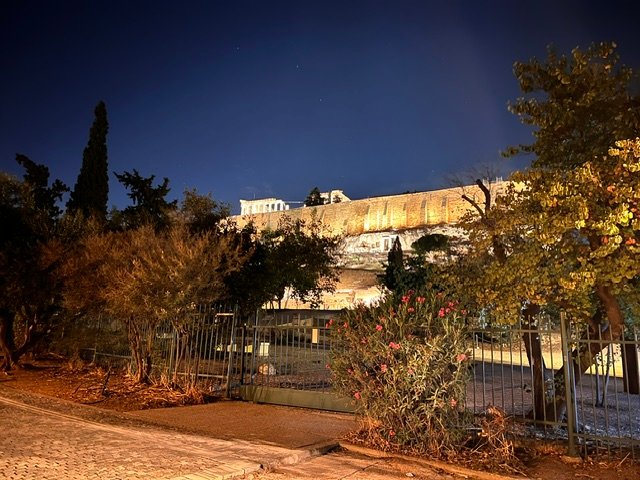
And then there was Athens itself.
It is difficult to walk around the city without constantly being reminded that you are walking through layers of history. Modern Athens sits directly on top of a city whose story stretches back thousands of years.
The Acropolis has been occupied since prehistoric times and became the great religious centre of ancient Athens. The buildings we associate with it today – including the Parthenon, Erechtheion, Propylaea and Temple of Athena Nike – largely date from the extraordinary building programme of the fifth century BC, during Athens’ Classical period.
Seeing them in photographs is one thing.
Standing underneath them is quite another.
Start with the Acropolis Museum
One decision we were particularly pleased with was visiting the Acropolis Museum before visiting the Acropolis itself.
It provided context that made the following day’s visit much more meaningful.
The museum brings together archaeological finds from the Acropolis and its slopes, with the Parthenon Gallery providing an excellent introduction to the sculptures and architectural elements of the great temple.
It also helps explain just how much history the Acropolis has witnessed.
The Parthenon was not simply an ancient building that survived untouched for 2,500 years. It has been a temple, a church and a mosque, and suffered enormous damage during the 1687 Venetian siege when gunpowder stored inside exploded. Much of the surviving sculpture was subsequently removed, most famously through the activities of Lord Elgin in the early nineteenth century.
Knowing some of that history before arriving at the top makes the experience considerably richer.
Exploring Athens
Our first afternoon was spent exploring some of the other major sights.
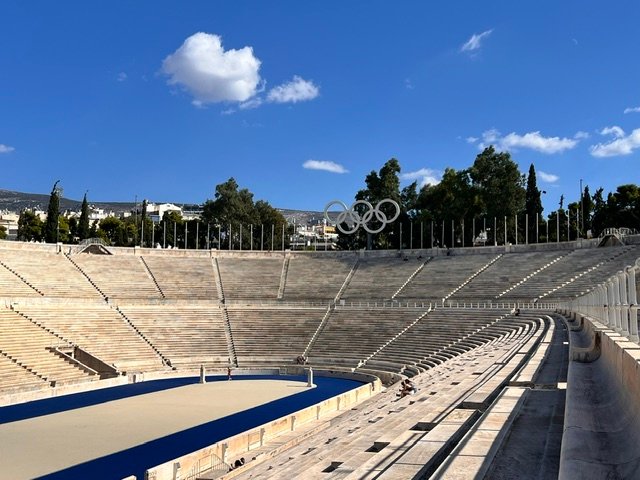
We visited the Panathenaic Stadium, the Temple of Olympian Zeus and various parts of central Athens before taking on Mount Lycabettus.
Calling it a walk perhaps undersells it.
It isn’t an expedition, but it provides a decent challenge, particularly if you’ve already spent much of the day exploring the city.
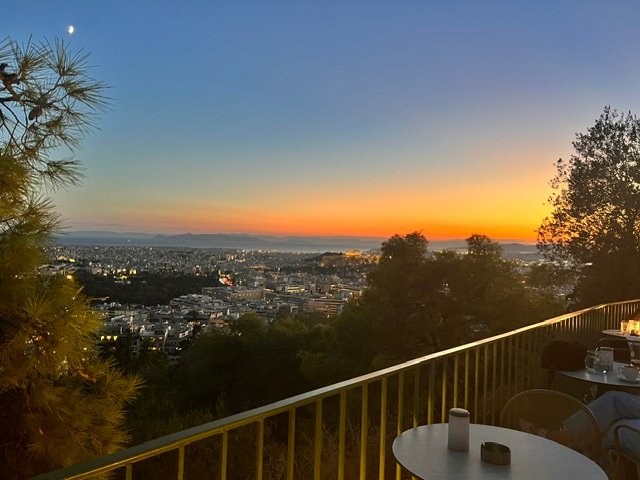
On the way up we stopped at Tenta Restaurant and Bar for a drink. Having reached the top of Lycabettus, we then made our way back down – only to find ourselves returning to Tenta.
And we were very glad that we did.
We sat down with a drink and watched the sun begin to disappear over Athens. From that elevated position the entire city seemed to spread out below us, with the Acropolis standing prominently among the rooftops.
Good food, a drink, a spectacular view and an Athenian sunset.
Sometimes the best travel experiences aren’t the ones that appear on the itinerary.
The Acropolis at 8am
The following morning began early.
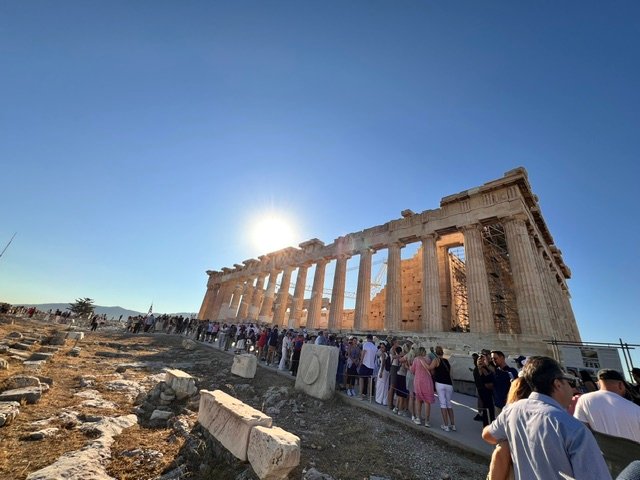
Our private guide met us at the hotel at 7:30am. Fortunately, we didn’t need a taxi or even a significant walk – the entrance to the Acropolis was essentially on our doorstep.
We arrived before opening time and took up a good position in the queue.
And that was a wise decision.
As 8am approached, the queue behind us grew steadily longer.
Once inside, we made our way upwards towards the Parthenon.
Even after seeing countless photographs, the reality of standing on the Acropolis is difficult to overstate. The Parthenon dominates the summit, but the surrounding ruins and the views across Athens are equally compelling.
The Acropolis flourished particularly during the fifth century BC, when Athens was at the height of its Classical power. The buildings created during this period remain some of the most recognisable monuments of the ancient world.
Our guide brought the ruins to life, explaining not just what we were looking at but why the buildings mattered.
After around three hours we descended and continued towards the Ancient Agoraand Monastiraki.
The contrast was striking: ancient Athens beneath our feet, followed by the noisy, colourful streets of modern Athens, packed with shops, cafés and bars.
That mixture is one of the things that makes Athens so interesting.
From Athens to Azamara Onward
After our whistle-stop exploration of Athens, it was time to head to Piraeus.
We had deliberately chosen to stay in Athens before the cruise rather than simply flying in and embarking immediately. In hindsight, it was absolutely the right decision.
Our driver, Dennis, collected us from the hotel and took us to the port.
And this was where Azamara immediately impressed us.
We arrived at around midday and, as soon as we stepped out of the taxi, our luggage was taken from us.
Check-in took perhaps five minutes.
By 12:30 we were sitting outside in the buffet restaurant, enjoying lunch.
Our bags arrived at our cabin around 2:30pm, giving us plenty of time to unpack and explore the ship before departure.
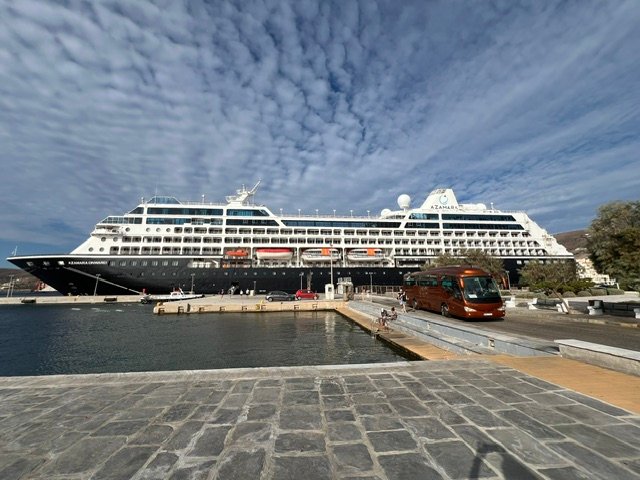
Azamara Onward is a very different proposition from a conventional large cruise ship.
It carries fewer than 700 guests, allowing it to use smaller ports and giving the whole experience a much more intimate feel.
For us, that was a major attraction.
We like cruising, but we don’t particularly want a floating resort packed with thousands of passengers. We prefer good food, good service, interesting destinations and a predominantly adult atmosphere.
Azamara fitted that description very well.
Sailing into the Greek islands
We sailed from Piraeus at 6pm.
There was no great fanfare. It was a relatively understated departure, which actually suited us.
We had already settled into our cabin, explored much of the ship and were ready for dinner at Discoveries.
We were fortunate enough to have a table with a sea view, and the food was excellent.
We had decided not to purchase a drinks package because a basic selection of drinks was already included in our fare.
That worked perfectly well for us.
The included wines, beers and spirits were perfectly respectable throughout the cruise. The cocktails available without the premium package weren’t quite at the same level, but we managed to survive!
Syros: a slower side of Greece
Our first island was Syros.
One of the pleasures of this itinerary was the variety of destinations. Some were familiar names, while others felt much more like genuine Greek island communities.
Syros was firmly in the latter category.
We enjoyed walking around the island and climbing towards the higher parts, where the views opened out across the Aegean.
There was a sense of everyday Greek life here that we found particularly appealing.
It was less about ticking off famous sights and more about wandering, looking, eating and enjoying the atmosphere.
That distinction became important as the cruise progressed.
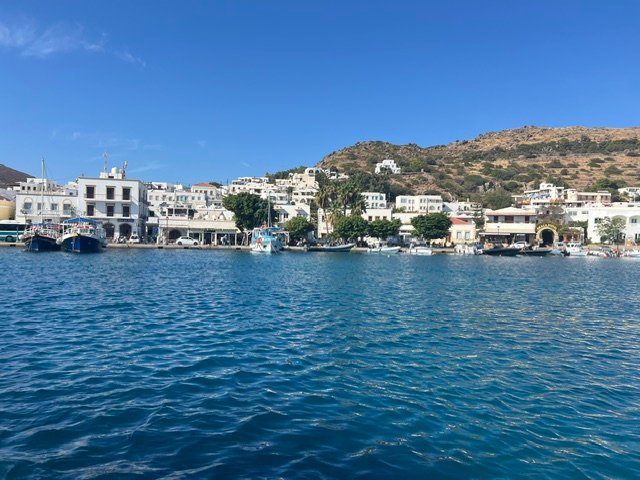
Patmos and the Cave of the Apocalypse
Patmos was another highlight.
The island is perhaps best known for its religious significance. According to Christian tradition, St John received the visions that became the Book of Revelation while on Patmos.
We visited the Cave of the Apocalypse, and it was one of those places where the history and the setting combine to make the experience particularly memorable.
The cave sits partway up the hill between Skala and Chora. Tradition identifies it as the place where St John received and dictated the visions recorded in Revelation. The site forms part of a UNESCO World Heritage property that also includes the historic settlement of Chora and the Monastery of Saint John the Theologian.
The monastery itself dates back to 1088 and was built as a fortified complex, partly reflecting the dangers faced by island communities at the time. Over the centuries, Chora grew around it.
Again, it wasn’t simply the history that made Patmos interesting.
We enjoyed the walk up into the hills, the views and the character of the island.
Of the destinations we visited, Syros and Patmos were among those we found most appealing.
Perhaps because they felt slightly less frantic.
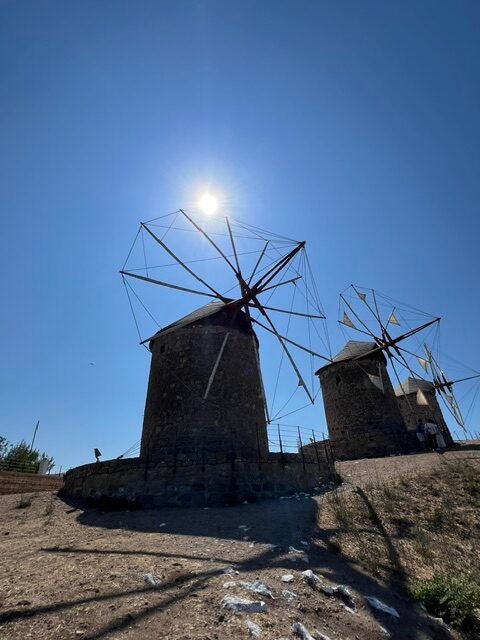
Rhodes and the busier side of Greece
Rhodes provided a sharp contrast.
Rhodes Town has a much stronger tourism infrastructure and a greater sense of bustle. Its medieval Old Town is fascinating, with the enormous walls and layers of Byzantine, Ottoman and medieval history providing a reminder that Greek history extends well beyond the Classical period.
We enjoyed our visit, although we found ourselves drawn more strongly to the quieter islands.
That was becoming something of a theme of the trip.
Marmaris and the Dalyan River
Our itinerary then took us across the Aegean to Turkey and Marmaris.
Marmaris surprised us.
The town is exceptionally green, with a huge marina and a beautiful setting surrounded by hills.
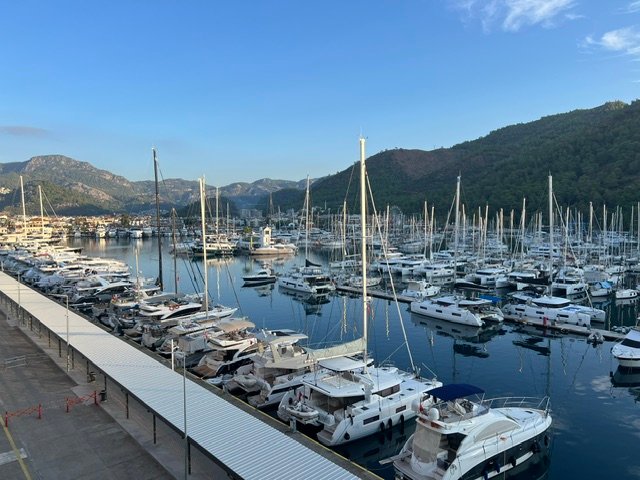
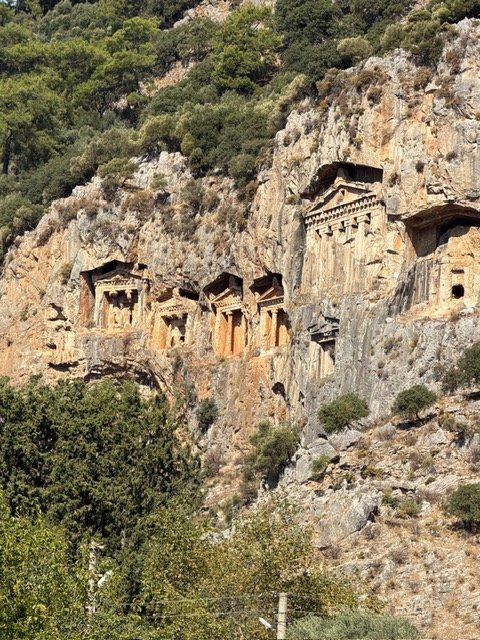
Our excursion took us along the Dalyan River towards Turtle Beach. During the tour, we witnessed the magnificent tombs of Kaunos, which are cut into the hill side. Built primarily during the 4th century BC, these monumental structures served as the final resting places for the kings, rulers, and wealthy elites of ancient Kaunos, a city in Ancient Caria.
It was another example of why small-ship cruising works so well for us. We could spend the morning exploring and then return to the ship without having to worry about transport, hotels or luggage.
The ship effectively became our travelling base.
Life aboard Azamara Onward
The cruise itself became part of the holiday rather than simply a means of transportation.
The food was consistently excellent, the bars were relaxed and the service was exceptional.
There were also two events that particularly stood out.
The first was the AzAmazing Evening, when Greek dancers came aboard and performed.
The other was the famous White Night, a party where all guests are politely requested to wear white – we duly obliged. A great night, with great music, though the queues for food were a bit long so we disappeared to the restaurant for dinner and returned to the party later.
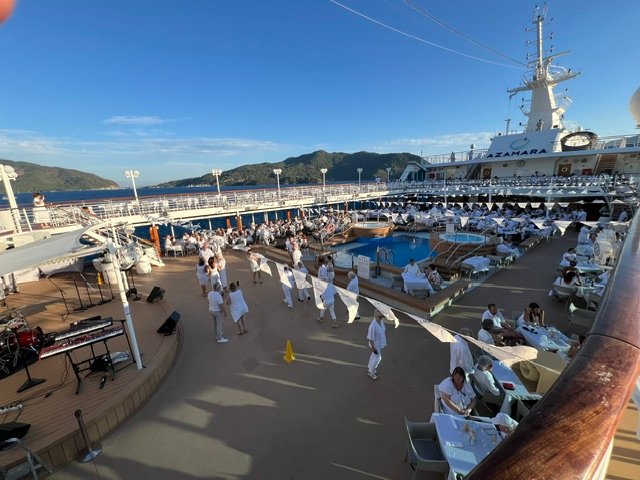
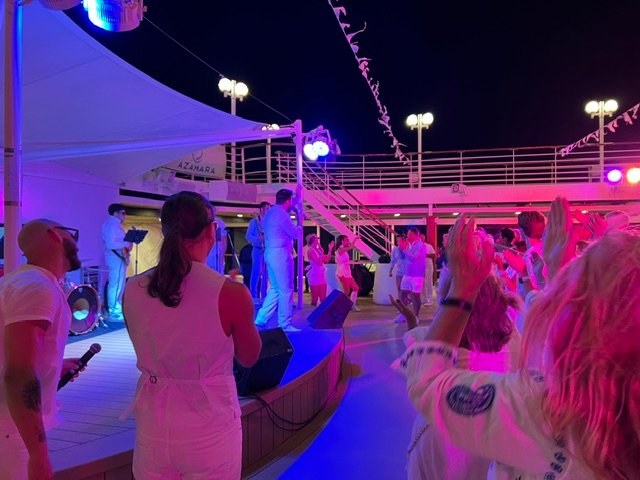
These are the sorts of experiences that you don’t necessarily plan for but end up remembering.
Agios Nikolaos and the journey towards Santorini
Our next stop was Agios Nikolaos in Crete.
Again, we had plenty of time to explore because of Azamara’s relatively long port stays.
This is another important distinction between Azamara and larger cruise lines.
The itinerary isn’t simply about getting you to a destination and then leaving again a few hours later.
Azamara deliberately builds longer stays into many of its itineraries, allowing passengers more opportunity to experience the destination. Our particular sailing included long calls at several ports, including Syros, Patmos, Rhodes and Agios Nikolaos.
For us, that makes a significant difference.
Santorini: choosing the right day
And then came Santorini.
This was probably the most anticipated stop of the cruise.
Santorini is one of those places where expectations can easily become a problem. It is spectacular, but it is also spectacularly popular.
We were fortunate.
Only two cruise ships, including ours, were tendering that day.
That made a huge difference.
Getting the cable car from the small harbour up to Fira was straightforward, and we then took a taxi across to Oia.
It wasn’t cheap – around €35 – but we felt it was worth it.
And Oia?
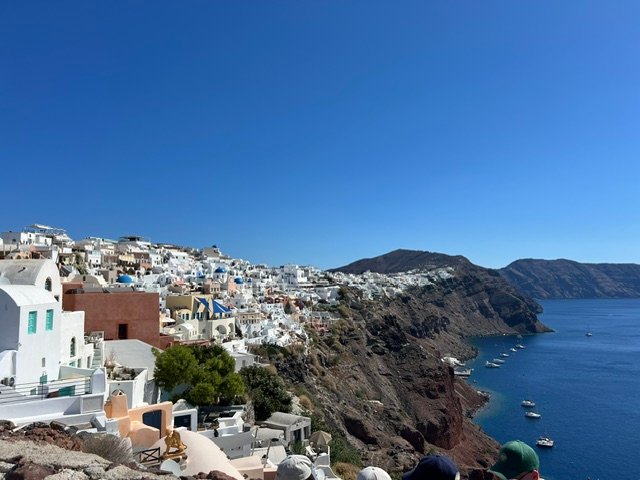
Perched on the volcanic cliffs of Santorini, Oia is a sun-bleached dream sculpted from light, stone and the infinite blue of the Aegean. Whitewashed buildings cascade down the volcanic hillside, punctuated by the familiar blue domes that have become one of the defining images of Greece.
There is a reason the photographs are so ubiquitous.
It really does look like that.
Santorini’s extraordinary landscape is itself the product of geological violence. The island’s volcanic history, including the enormous eruption of the Bronze Age, helped create the caldera and dramatic cliffs that make the island so distinctive.
Standing in Oia, looking across that enormous sweep of blue water, it is easy to forget that the landscape was created by one of the most powerful natural events in the region’s history.
We spent our final day and evening enjoying Santorini before returning to the ship.
It was a fitting end to the cruise.
Would we cruise Azamara again?
Yes.
Without hesitation, we would consider Azamara again.
For us, the appeal is quite specific.
We don’t need a huge range of entertainment, water slides, children’s facilities or dozens of restaurants. In fact, quite the opposite.
We want somewhere that feels relaxed and predominantly adult, with good food, excellent service and interesting destinations.
The size of Azamara Onward means that the ship can get into smaller ports that are inaccessible to much larger cruise ships. That changes the nature of the itinerary.
And the service is excellent.
There is also something wonderfully easy about returning to the ship after a day exploring, knowing that your cabin is waiting, your luggage is already there and dinner is only a few hours away.
Our one regret?
We probably made too much use of the ship’s hospitality and too little use of the excursions.
The excursions available looked excellent, and on a future Azamara cruise we’d probably book more of them. We should add that our preferred cruise agency is Panache Cruises (https://www.panachecruises.com), who provide good pricing and excellent support. Our main contact is Jason Treadwell, and we will continue to book future cruises via Panache.
Ten days, and a lot of Greece
Eventually, the ten days came to an end.
On our final morning we returned to Piraeus in heavy rain.
It seemed strangely appropriate.
Dennis was waiting for us at the port to take us back to Athens airport, and before long we were heading home.
Ten days earlier we had left Heathrow for Athens.
In between, we’d walked among the ruins of Classical Athens, stood beneath the Parthenon, climbed Lycabettus, watched the sunset over the city, visited the Cave of the Apocalypse on Patmos, explored Greek islands, crossed the Aegean into Turkey, enjoyed Greek food and wine, danced at a White Night party and watched Santorini rise from the sea.
It was a busy ten days.
But it never really felt rushed.
And perhaps that is what made the combination work so well.
Athens gave us the history. The islands gave us the variety. Azamara gave us the time to enjoy both.
For us, that made this much more than simply a Greek cruise.
It was a very considered way to experience Greece.
The Considered Traveller rating of Athenswas Hotel: ★★★★
The Considered Traveller rating of Azamara Onward★★★★½
Our highlights
- Best Meal: Prime C restaurant
- Best setting: Santorini
- Best town: Patmos
- Best atmosphere: White Night
- Biggest regret: Not doing more excursions
- Would we use Azamara again? Absolutely.